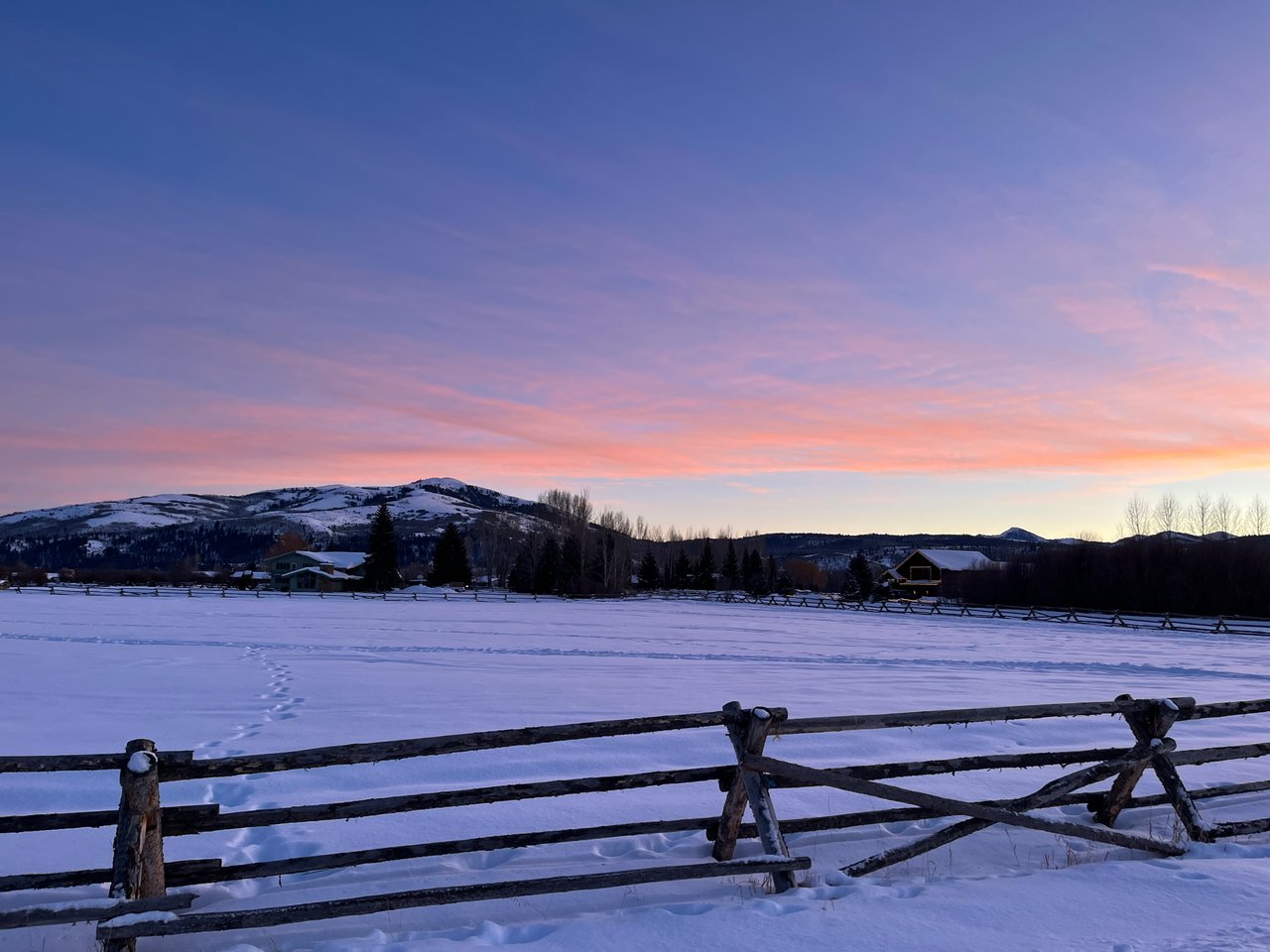
You close on a parcel outside town, picture the split-rail fence line that runs along half the driveways in the valley, and call a fencing contractor. That's usually when the surprise arrives. In unincorporated Teton County, whether you're allowed to build that fence has almost nothing to do with your budget, your builder, or what the neighboring properties look like. It comes down to two numbers most buyers never check before closing: how many acres you own, and how the county assessor classifies the land.
Get the classification wrong and a fencing plan that looked routine on paper turns into a Special Purpose Fencing application, a wait for Planning Department review, or a redesign after the fact.
The fence most buyers picture
The buck-and-rail fence, the three-dimensional wooden zigzag that shows up in postcards and real estate photography across the valley, is the fence most people associate with Jackson Hole. It's also the fence unincorporated Teton County has restricted for new construction since a 2021 rewrite of its Land Development Regulations. Under LDR Section 5.1.2, new buck-and-rail and buck-and-wire fencing require approval from the Planning Director rather than going up as a matter of course. The design that looks most like classic Wyoming ranch country is precisely the one the current code was written to limit.
That change didn't happen quietly. The Board of County Commissioners spent two hours-long hearings on it, took public comment twice, and worked through drafts with the Teton Conservation District, Wyoming Game and Fish, and the Jackson Hole Wildlife Foundation before approving the update in a 5-0 vote. Wyoming Game and Fish wildlife biologist Aly Courtemanch told commissioners the update would improve wildlife permeability across the valley and reduce direct mortality and injury from fence collisions. That framing, permeability and injury rather than aesthetics, is the lens the entire code is built around, and it matters for anyone trying to figure out where their own property falls.
What the code actually requires
For a fence to go up without a permit in unincorporated Teton County, it generally needs to meet these standards:
- No higher than 38 inches above the ground for most fencing, or 42 inches where livestock containment is the purpose
- At least 12 inches of vertical spacing between the top two wires or rails
- No more than three horizontal strands or rails total
- Roughly 18 inches of clearance between the ground and the lowest wire or rail, so young or small animals can pass beneath
- No new buck-and-rail or buck-and-wire construction without a Planning Director exemption
Meet those specs and the fence typically doesn't need a permit at all. Deviate from them, for a pool enclosure, a kennel, a small yard, or a design preference, and the property owner has to file a Special Purpose Fencing application through the county's SmartGov portal before building. That's the mechanical part of the rule. The part that catches people off guard is who doesn't have to follow it in the first place.
The 70-acre line
The 2021 amendment carved out one significant exemption: agricultural fencing, new or old, on parcels of 70 acres or more that the county assessor classifies as agricultural. Those properties sit outside the fencing code entirely. A working ranch above that threshold can put up a conventional livestock fence at whatever height and design its operation requires, and an existing buck-and-rail line on that same parcel doesn't need to come down or be brought into compliance.
Drop below 70 acres, or hold land the assessor doesn't classify as agricultural regardless of size, and the full code applies. A 20-acre horse property, a 10-acre homesite inside a platted subdivision, or a smaller parcel purchased with the idea of eventually running a few head of livestock all fall under the same height, spacing, and material rules as a residential lot in town. Subdivision covenants that specify a traditional rail fence don't override the county code for new construction. The acreage and the assessor's classification decide the outcome, not the deed restrictions and not the buyer's intent.
This is worth confirming before writing an offer, not after closing. A property's use in practice, keeping horses, running a small herd, doesn't automatically earn agricultural status. That classification comes from the assessor's records, and it's worth verifying directly with the county rather than assuming from how the seller has been using the land.
Why the line sits where it does
The reason the county drew the exemption at ranch scale rather than at any fence height buyers might prefer traces back to migration. Teton County sits along routes elk and mule deer travel between Wyoming's Red Desert and the valley floor, following the snowline as it retreats each spring. The corridor connecting Teton County to Sublette County to the south carries the Path of the Pronghorn, the first federally designated migration corridor in the country. Fences built without wildlife in mind sit directly across those paths.
The cost of that has been measured. A 2005 study found that for roughly every 2.5 miles of fencing, an ungulate dies in it each year. In the hard winter of 2023, thousands of pronghorn died after record snowfall pushed them off their usual routes and into fence lines that blocked the detours. That's the backdrop for a program that isn't part of the code at all: the Jackson Hole Wildlife Foundation has run volunteer fence removal projects since 1996, and this year marks the program's 30th anniversary. Volunteers have pulled more than 240 miles of derelict fencing across western Wyoming in that time.
One recent example sits just south of Hoback, at the Broken Arrow Ranch, where the fence bordered Bridger-Teton National Forest near an elk feedground and native winter range. The horses on the property never grazed up to that boundary, so the fence had become pure obstacle with no working purpose left. The landowner reached out to the Wildlife Foundation directly, and volunteers spent a day pulling roughly a third of a mile of wire while another crew installed a friendlier electric fence around the horse pasture instead. Robb Sgroi, the Teton Conservation District's land resources specialist, has noted that even with federal land managers keeping reasonable inventories, nobody has a complete countywide map of what fencing exists on private land or where. That gap is part of why the 2021 code leans on landowners to know their own fence lines and their own classification, rather than assuming the county will catch what doesn't comply.
What's still moving this fall
The 70-acre threshold and the fencing standards themselves aren't the end of the story for buyers this year. Teton County and the Town of Jackson are separate jurisdictions with separate codes, and the town has been weighing its own fencing update, with the county's Principal Long-Range Planner Ryan Hostetter fielding a wide range of public comment on it, from residents worried about over-regulating private property to residents pushing for stronger wildlife protections. That discussion has been expected to move forward this fall.
For a buyer, this makes jurisdiction the first thing to confirm, not an afterthought. A parcel that reads as "Jackson" in casual conversation may sit inside the Town of Jackson's limits, where a separate and possibly soon-to-change fence code applies, or in unincorporated Teton County, where the standards above and the 70-acre exemption govern instead. The county's GIS mapping system marks town limits directly on the parcel map, and it's worth checking before assuming which set of rules applies to a specific piece of land, particularly for property near the edge of town where the boundary isn't obvious from the road.
What this means before you close
For anyone under contract on land in unincorporated Teton County, a short list is worth working through before the fence goes up:
- Confirm whether the parcel is inside Town of Jackson limits or in unincorporated county land, since the codes differ and the town's may change this fall
- Check the assessor's classification and confirm the parcel clears 70 acres before assuming the agricultural exemption applies
- If an existing fence on the property is already non-conforming, know that the code allows a one-time repair of up to 25 percent of that fence under a special permit, not the 50 percent with no time limit the older rule allowed
- If the fence you want doesn't meet the height, spacing, or material standards, plan for a Special Purpose Fencing application and the review time that comes with it, rather than assuming a straightforward build
None of this changes what land in Teton County is worth or what it can become for a buyer. It changes the order of operations, confirm classification and jurisdiction before you plan the fence, not after the crew shows up.
A few questions worth asking directly
Does the county rule apply the same way inside Town of Jackson limits? No. The town and the county are separate jurisdictions with their own codes, and the town has been considering changes to its own fence standards this fall. Confirm which jurisdiction a parcel sits in before assuming either code applies.
If my land is used for horses but is under 70 acres, do I still get the agricultural exemption? No. The exemption requires both the 70-acre threshold and an agricultural classification from the county assessor. Use alone, without the acreage and the classification, doesn't qualify a property.
Can I keep an existing buck-and-rail fence if I buy a property that already has one? The 2021 code addresses non-conforming fences with a one-time allowance to repair up to 25 percent of the fence under a special permit, rather than requiring full replacement. Confirm the specifics with the Planning Department for the property in question, since repair history and prior permits can affect what's allowed going forward.
Fence codes rarely make anyone's must-ask list before an offer, but on land in Teton County, this one shapes what a property can look like, how it can be used for livestock, and how much flexibility a future owner will have to change it. If you're evaluating acreage, a homesite, or a working ranch parcel and want a clear read on how the classification and jurisdiction questions apply to a specific property, the team at The Legacy Group works through exactly this kind of due diligence with clients before they write an offer. You can start by browsing current Teton County properties or reach out directly to talk through a specific parcel.