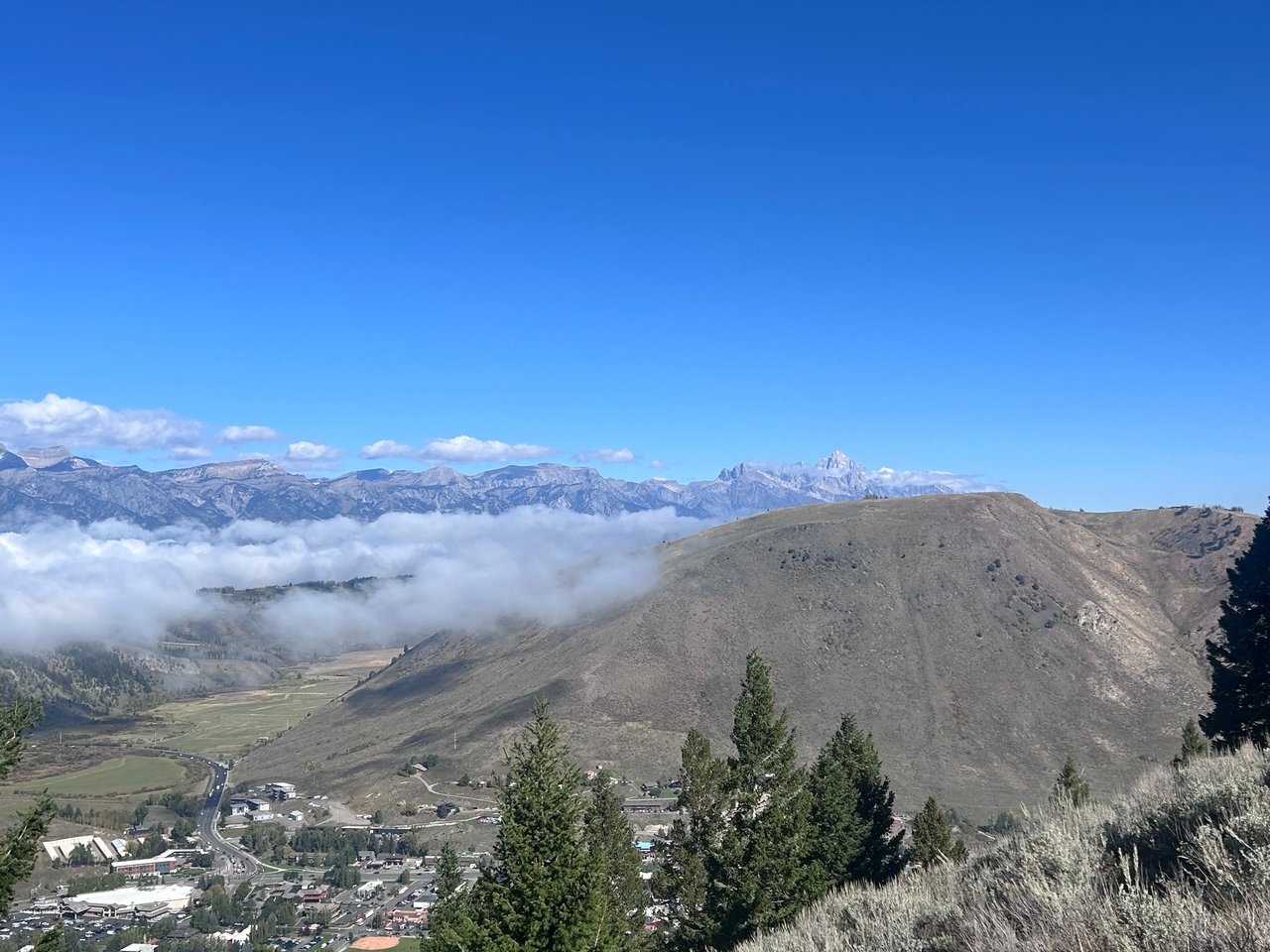
High School Butte does not look like it holds four different chains of title. It looks like a steep dirt scar off South Park Loop Road, the kind of hill locals duck out to before dinner because it climbs fast and dries out early. Its real name, according to county maps, is Antelope Butte. Almost nobody uses that name, because almost nobody who hikes it has ever needed to know who owns the ground under their feet.
That changed this month, and the reason had nothing to do with the trail itself.
The Presbyterian Church of Jackson Hole put its 3.74-acre parcel at the base of the butte on the market for $1.45 million. The land includes the trailhead, the spot where South Park Loop Road meets South High Country Drive and where the switchbacks begin. For a few days, the buyer was anonymous, and residents who treat this hill as a daily habit started asking what an unknown owner might do with it.
A Hill Owned in Four Pieces
Before this sale, the butte was never protected as a whole. It was protected in fragments, assembled over more than twenty years by different institutions solving different problems.
Near the summit sits a 40-acre parcel that the Henry Oliver Jr. Trust placed under a conservation easement back in 1998, granted by Emily Frew Oliver to the Jackson Hole Land Trust. That upper section was closed to public foot traffic entirely in 2013, after years of littering, social-trail damage, and even a meth lab discovered on the hillside. Below that, the Teton County School District owns the ground where the trail's switchbacks actually cut across the slope, built with volunteer labor from the Land Trust, the Teton Conservation District, and Friends of Pathways starting in the mid-2000s. In 2020, the Land Trust separately bought an adjacent 18-acre parcel from a private family, brokered through agent Greg Prugh, specifically to formalize access to the trail's upper reaches and protect wildlife habitat next to its other easements.
That left one piece unaccounted for: the 3.74 acres at the very bottom, where hikers actually step off the pavement. That piece belonged to the church, and it belonged to the church on the strength of decades of goodwill rather than any recorded easement. The land trust president, Max Ludington, put it plainly when the county debated funding the purchase: the parcel "gets tons of use from wide swaths of the community, mostly local use." It was the one link in the chain that had never been secured.
A Housing Problem, Not a Trail Problem
The church did not decide to sell because the trail had gotten too popular or too worn. It decided to sell because it could not keep its own staff housed.
Like many employers across the valley, the church has spent more than a decade losing valued team members to Jackson Hole's housing costs. In 2024, the Jackson Town Council approved its plan to build 21 deed-restricted townhomes for employees directly across the street from the trailhead. The first phase called for 10 of those homes. The congregation raised roughly $8.5 million toward that goal, enough to finish seven units. The remaining three homes in that first phase are what the land sale was meant to fund.
In other words, a favorite in-town hike almost changed hands over a staffing and housing math problem playing out one street away, not because of anything happening on the hillside itself. Board member Becky Kimmel said the leadership felt strongly about finding a buyer who would keep the trail open to the public, and by Friday's announcement, that buyer had a name: the Jackson Hole Land Trust.
What $750,000 in Sales Tax Actually Bought
Two business days after the Land Trust was named as the intended buyer, Teton County commissioners voted unanimously to put $750,000 toward the purchase. The money is not new taxation. It comes out of a pool voters already approved in 2022, an $8 million specific purpose excise tax, essentially a one-penny sales tax earmarked for land conservation, wildlife habitat, and public access across the county. Commissioner Natalia Macker said she hoped the funding would put lingering concern about the trail's future "to bed."
That approval covers most of the purchase price, but not all of it. As of this week, the Land Trust is still short roughly $100,000, and it is asking a private family, not the church, not the county, to close that final gap with a donation.
Why the Ask Is Foot Traffic, Not Just Money
Rather than run a straightforward fundraising campaign, the Land Trust is spending the final week of September asking people to show up and hike. From September 28 through October 3, the organization is aiming for 1,000 hikers on High School Butte, with local business partners offering after-school incentives between 3 and 6 p.m. on weekdays, including free bike tune-ups and cookies.
The logic is direct. A donor family weighing whether to fund a $100,000 gift is more likely to act if the turnout makes the case for them. A thousand pairs of boots on a short, steep trail is a harder number to argue with than a spreadsheet. If the campaign works, ownership of the parcel moves from the church to the Land Trust, and the Land Trust has already said its next step is to place a conservation easement on the property and then transfer the land to the Town of Jackson.
A Different Kind of Protection Than This Hill Has Seen Before
That last detail is worth sitting with, because it is not how most of this butte's protection has worked so far. The 1998 easement on the summit parcel and the 2020 purchase of the 18-acre parcel both kept land in private or nonprofit hands, with development rights removed but ownership unchanged. This deal ends differently. After the easement is recorded, the trailhead parcel is meant to become property of the Town of Jackson outright.
Current zoning on the 3.74 acres only permits a single home, so the development pressure here was already modest. But town ownership removes even that possibility and puts long-term decisions, trail maintenance, signage, future rerouting, in the hands of a public body answerable to residents rather than a private landowner working through succession, sale, or shifting institutional needs. For a trail assembled piece by piece by a school district, a family trust, a private family, and a church, this is the first piece meant to belong to the town itself.
None of this changes what the hike feels like on a Tuesday evening in October. The switchbacks are the same switchbacks Friends of Pathways volunteers cut into the hillside twenty years ago. What changes is who you'd call if a section washed out or a fence line moved, and for a trail this many people in Jackson treat as a daily fixture, that answer was genuinely unsettled for about a week this month.
If you want to see how it resolves, the Land Trust's hike-a-thon runs through October 3, and showing up is the whole ask.
We spend a lot of our time at The Legacy Group thinking about how land in this valley gets protected, who ends up holding it, and what that means for the people who live around it. High School Butte is a small hill with a complicated title history, and it is exactly the kind of story we like following.