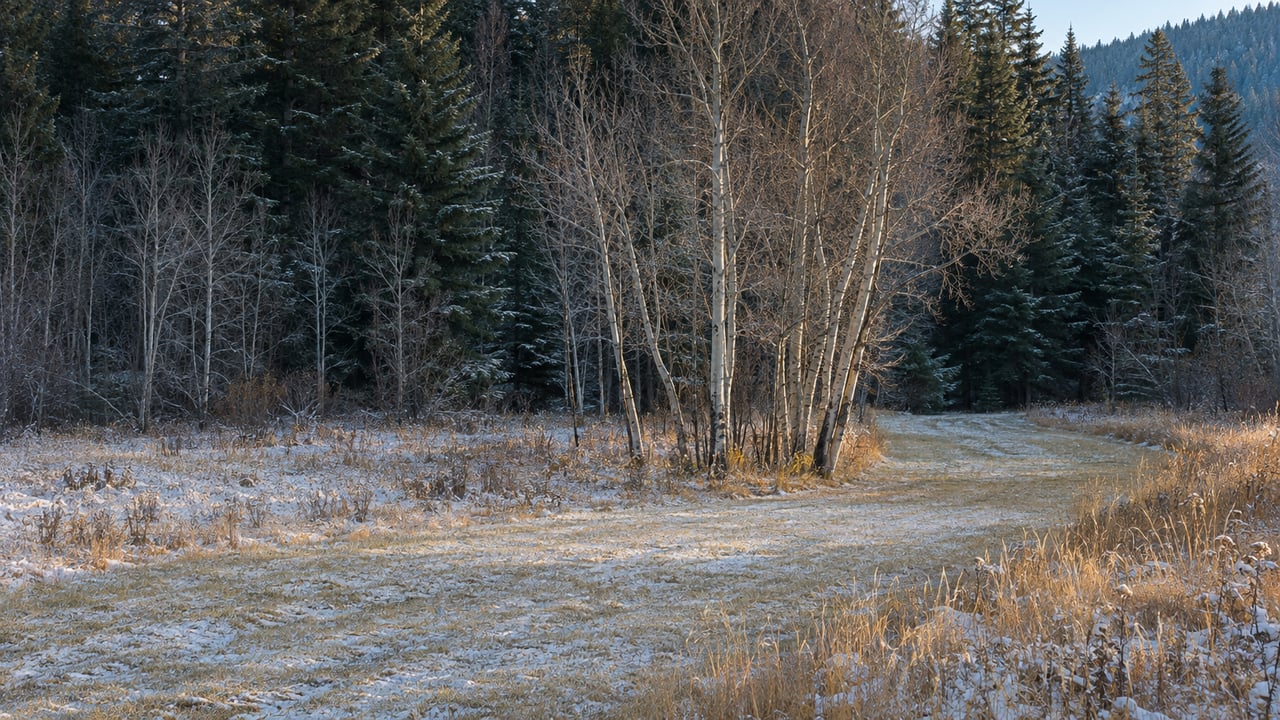
October cleanup day at Trail Creek is the Jackson Hole Ski & Snowboard Club's own version of putting up hay. According to the club's November Nordic Newsletter, volunteers stained the cabin and the wax building, chopped and stacked eight cords of firewood, and mowed the trail at Beaver Ponds. They also pulled invasive weeds, fixed the ranch gate, pruned the apple tree in the stadium, built a retaining wall in front of the Junior cabin and waxed hundreds of pairs of lease skis. The newsletter's writer thought it might have been the most productive cleanup the club has had.
The club also took on a bigger job that month. A donor bought the club a deck mower, and for a week in October, with a club parent's tractor helping, crews mowed every trail on every land designation the system crosses. That included many trails on U.S. Forest Service land, which the newsletter says may have been mowed for the first time ever.
Why a Mower Matters on a Ski Trail
Tall grass and brush hold snow up off the ground, so a groomer needs a deeper base before it can set a usable track. Short-cut trails let grooming start on a thinner snowpack. The club is direct about the goal: mowing lets it "start grooming and skiing when there is less snow on the ground, which hopefully means an earlier season for all the kids in the club and community members."
The cabin area got similar treatment. Another club parent's tree company was removing aspens for a client down the street and gave the club three full truckloads of wood chips for free. The chips were spread around the cabin, which the club says means less mud, more level footing for the machines and the bathrooms, and less snow needed before grooming can start.
Three Landowners, One Trail Map
The mowing covered every land designation because Trail Creek runs across more than one owner's ground. The club describes the Trail Creek Nordic Training Facility as the product of "a collaborative partnership between Trail Creek Ranch, the Seiffert Family, and the United States Forest Service," and adds that "all entities have separate restrictions and needs that users must abide by to continue skiing here."
That arrangement explains most of the rules skiers see at the cabin. The club's season pass page says part of the facility is on private property, and that skiers should respect the property rights of those who let the club use their land free of charge. The club is also an authorized permittee of the Bridger-Teton National Forest, so anyone skiing the Forest Service portion accepts the Forest Service's acknowledgement of risk when buying a pass.
The Permission That Started It in 1964
The partnership goes back to one landowner's yes. The Jackson Hole Historical Society records that Elizabeth "Betty" Woolsey was born December 28, 1908, competed in the 1936 Olympics, bought Trail Creek Ranch and opened it to guests, and died in 1997.
The club's history page fills in the rest. Woolsey made the first U.S. women's ski team in 1935 and was the top American woman in the downhill at the 1936 Games. During World War II, when the U.S. team trained in Sun Valley and at Mount Hood, she took a side trip to Jackson Hole over Teton Pass. That was her first look at the land at the base of the pass, which she bought in 1943. Trail Creek Ranch began taking guests in 1948.
In 1964, Johnny Curtis asked her whether he could groom some trails and ski at Trail Creek with about half a dozen kids. Her permission, the club writes, "began a relationship that lasted for the next fifty years," and the Jackson Hole Ski Club Nordic Program grew out of it. The club set up the Betty Woolsey Olympian Endowment in 1992. It funds merit-based scholarships every year. The Jackson Hole News&Guide has made the same connection, noting that the land Woolsey bought at the base of Teton Pass later became Trail Creek Nordic Center.
Those six kids have turned into what the Jackson Hole Nordic Alliance calls "a delightful chaos" on weekday afternoons, with club skiers from the youngest Lollipoppers up to the Comp Team on the trails at once.
What a Trail Creek Pass Commits You To
Most Nordic passes buy you access. The Trail Creek season pass has also come with obligations. The first stipulation on the club's 2025–26 season pass page, which the facility page still links to, spells that out:
"This is a Club -not a service- we will do our best to provide great skiing, but in purchasing this pass - you are agreeing to provide help in fall and spring clean up, youth races, and other Club functions."
So the people who stacked those eight cords of firewood are, in part, the people who ski there. The club's most recent season pass page also notes that rates went up to cover rising expenses, including a new site usage fee.
The other rules on that 2025–26 page follow from the land arrangement. For this season's terms, check with the club before you buy:
- Daily fee. Skiers without a season pass pay a $20 daily trail fee on site. The Nordic Alliance's guide says the fee box is on the front steps of the cabin.
- Daylight only. The facility is open for daylight use only.
- Parking. Park only on the left side of Old Pass Road, past the first house, and leave room for vehicles pulling out of the new driveway. Watch for the driveway crossing on the way into the trails.
- Marked trails. Stay on marked trails, and don't change anything on the property without permission from the Nordic Program Director.
- Display your pass. Season pass holders show their pass every time they ski.
- Tracks are for skiers. Snowshoers and dog walkers are asked to stay off the designated skier tracks. The Nordic Alliance's guide lists Trail Creek among the systems where dogs are not allowed. For skiing with a dog, it points to Cache Creek, Emily's Pond and Shooting Star.
The Nordic Alliance describes the system as 14 km of trails with good hills and a mix of meadow and forest. To get the grooming report, send an email or text to [email protected]. For questions, the club lists 307-733-6433 from April through November and 307-733-0296 from December through March.
Three Race Saturdays at Trail Creek
Trail Creek hosts three stops on the 2026–27 WYDAHO Nordic Race Series, which opens at Grand Targhee on December 5 with the Targhee Tune-Up.
| Date | Race | What's known now |
|---|---|---|
| Sat., Dec. 19, 2026 | Betty Woolsey Classic | Named for the landowner who first said yes; distances, start times and registration will be posted closer to race day |
| Sat., Feb. 13, 2027 | Skinny Skis Moose Chase | Freestyle only, with 20K, 10K, 5K and 2.5K races plus a free 1K |
| Sat., Mar. 13, 2027 | Skinny Skis Season Finale | The last race of the series; details and registration still to come |
The Moose Chase is the one with posted details. The club's Moose Chase page describes it as a race for all ages and ability levels, with no classic division and no classic track. The 20K and 10K start at 9:30 a.m., the 5K at 10 a.m., the 2.5K at 10:30 a.m. and the 1K at 10:40 a.m. Parking at Trail Creek is very limited, so the club asks racers and spectators to take a shuttle from Stilson Ranch.
For adults who want instruction on the same trails, the club's Recreational Nordic Masters clinics include four sessions at Trail Creek, alternating classic and skate on January 28 and February 4, 11 and 18. The full eight-clinic package is $600 and includes day passes to Teton Pines and Trail Creek on clinic days. A classic-only or skate-only package of four clinics is $425.
The trails are mowed, the firewood is stacked and the wood chips are down around the cabin. The next thing Trail Creek needs is snow. Until the season opens, the grooming report email list is the quickest way to find out when the first track is set.
At The Legacy Group, we're always glad to share what we know about the trails, ranches and families at the base of Teton Pass. If you'd like to talk about the Trail Creek area or the rest of the west bank, we'd be happy to hear from you.