Sometime in early October, on a still night when the propane furnace in the crawlspace hasn't kicked on yet and the windows are still cracked, a boom rolls across Spring Gulch Road. Not thunder. Not a gunshot. A flat, hollow concussion that repeats every few minutes for an hour, then stops. If you've lived in Jackson Hole Golf and Tennis long enough, you've heard it and shrugged it off as some rancher's business. If you're newer, you've probably lain there wondering if you should call someone.
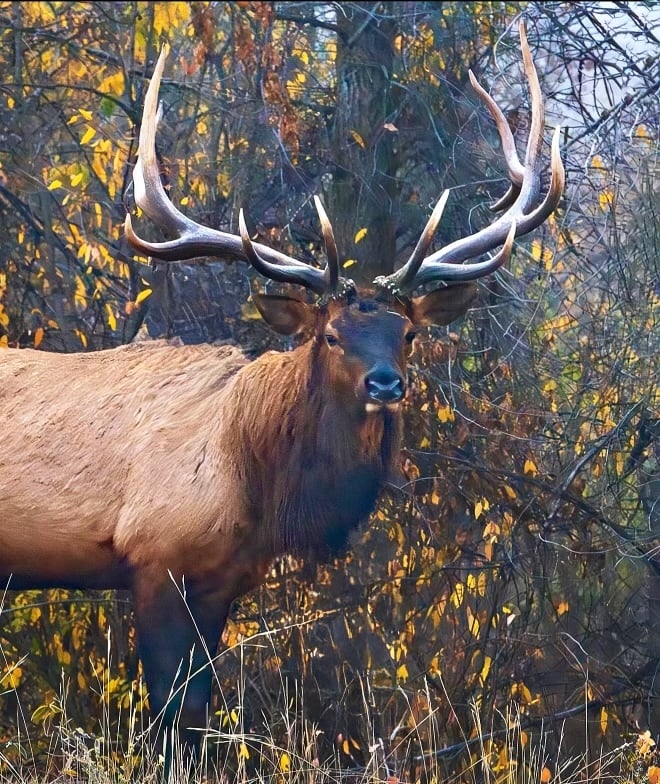
You shouldn't. What you're hearing is a propane cannon, and it's doing exactly what it's supposed to do: moving several hundred elk off a neighboring hayfield and pointing them toward Grand Teton National Park, on a route that runs directly past your house.
The noise has an author
In one documented account, a Wyoming Game and Fish warden named Jon Stephens described driving a green pickup out to Spring Gulch each fall to haze elk off private hayground with propane cannons and inflatable tube men, the same devices you'd see guarding a cornfield from crows, scaled up for five-hundred-pound animals. The elk post up near cattle and raid haystacks, which ranchers won't tolerate, so the cannons go off until the herd moves on. Stephens said the complaints started almost immediately from "people by Golf and Tennis" who couldn't sleep through it, and there's no version of the job that avoids that trade-off. Push the elk off the ranch and the neighborhood absorbs the noise. Don't push them, and the rancher takes the loss.
What makes this worth knowing, rather than just enduring, is the route itself. Russ Lucas, one of Spring Gulch's largest landowners, described the pattern plainly in that same account: when elk come down off the mountain, they don't wander randomly, they go through Golf and Tennis and out the other side to the park, every year. The corridor isn't incidental. It's the path of least resistance between the hayfields to the south and the protected ground to the north, and this neighborhood sits squarely in the middle of it.
Three closures, only one of them fixed
Ask anyone here when the "season" ends and they'll probably point to the golf course. Jackson Hole Golf & Tennis Club runs its 18 holes from early May to mid-October, a window set by the club and nudged by snow, frost, and staffing rather than by any outside authority. It's a soft date. Some years it stretches a little later if the weather holds.
The pathway closure is not soft. The multi-use path along Highway 89 between Flat Creek and the Gros Ventre River, the route many residents use to bike or walk toward town, closes every year on November 1, regardless of whether there's snow on the ground yet or leaves still on the cottonwoods. That date isn't chosen for cyclists' convenience. It's set to keep people and dogs off a stretch of ground the elk herd needs clear while it's funneling south toward the National Elk Refuge, where a herd that can run into the thousands typically becomes visible from mid-December through early April.
Lay the two dates side by side and the neighborhood's real calendar comes into focus:
- Early May to mid-October: golf course open, flexible on the back end, weather-dependent
- November 1: Highway 89 pathway closes, fixed regardless of weather, set to protect the migration corridor
- October through December: elk actively moving down from summer range into the valley, funneling past Spring Gulch and through Golf and Tennis toward the park
The golf course closing feels like the season's edge because it's the one with a clubhouse and a scorecard attached to it. But it's the pathway closure, driven by an animal's schedule rather than a groundskeeper's, that actually restricts what residents can do and where they can walk a dog through the back half of fall.
The weeks nobody puts on a calendar
Here's the part that doesn't show up in any club newsletter. Between the last tee time in mid-October and the first hard freeze that lets the club start grooming snow, there's a stretch of a few weeks when the golf course is neither a golf course nor a ski track. It's just open ground, mowed fairways with nothing scheduled on them.
That gap is not empty. It's exactly the window the elk are using. The same acreage that hosted a foursome in September becomes, a month later, the stage for several hundred animals moving through at dawn or dusk, watched by nobody except whoever happens to be up early enough to see them cross a fairway on their way to the tree line. The golf season's off-ramp and the elk migration's on-ramp occupy the same weeks on the same ground, which is part of why the noise complaints and the wildlife sightings cluster in the same short stretch of the calendar every year.
What the fairways become once the ground freezes
Eventually the gap closes on its own terms, when enough snow falls to groom. At that point the same 18 holes that Robert Trent Jones Jr. redesigned turn into a Nordic ski track, roughly seven miles of loops carved into the back nine and the surrounding cottonwoods and aspens. The main section runs as an out-and-back with a wide loop at the far end, crossing Spring Gulch Road twice along the way, marked by red-topped stakes so the route stays visible even after a fresh storm. It's groomed seven days a week, though the clubhouse building itself closes on weekends and is open midweek to members only.
The ground's ability to run three different jobs a year traces back further than most residents realize. The club was first envisioned by Paul McCollister in 1958, built out in the late 1960s under Laurance Rockefeller and the Grand Teton Lodge Company, and later rebuilt with roughly $15 million in improvements under Vail Resorts, including the Robert Trent Jones Jr. course redesign that's still in play today. None of those owners were planning around elk. They were planning around golf and, eventually, skiing. The wildlife corridor was already there, running through land that happened to get graded flat and irrigated green, which is part of why the two uses now sit so close together on the same acres.
For anyone weighing a fall or winter stay here, none of this is a downside so much as a fact worth knowing before the first cannon goes off. Membership at the club is currently sold out, with new interest going onto a waitlist coordinated by Assistant General Manager Steve Cole rather than an open sign-up, so the golf and pool side of the property runs at a different pace than it did a decade ago. The Nordic track and the migration corridor, by contrast, don't require membership to notice. You just need to be outside at the right hour, or awake at the wrong one.
Living inside a migration corridor changes what a fall evening sounds like and what a November walk actually involves, and that's the kind of detail that's easy to miss until you've spent a season here. If you're weighing what a specific home in Jackson Hole Golf and Tennis actually looks and sounds like across all three of its seasons, not just the one shown in a listing photo, The Legacy Group can walk you through it property by property. Work With Us.